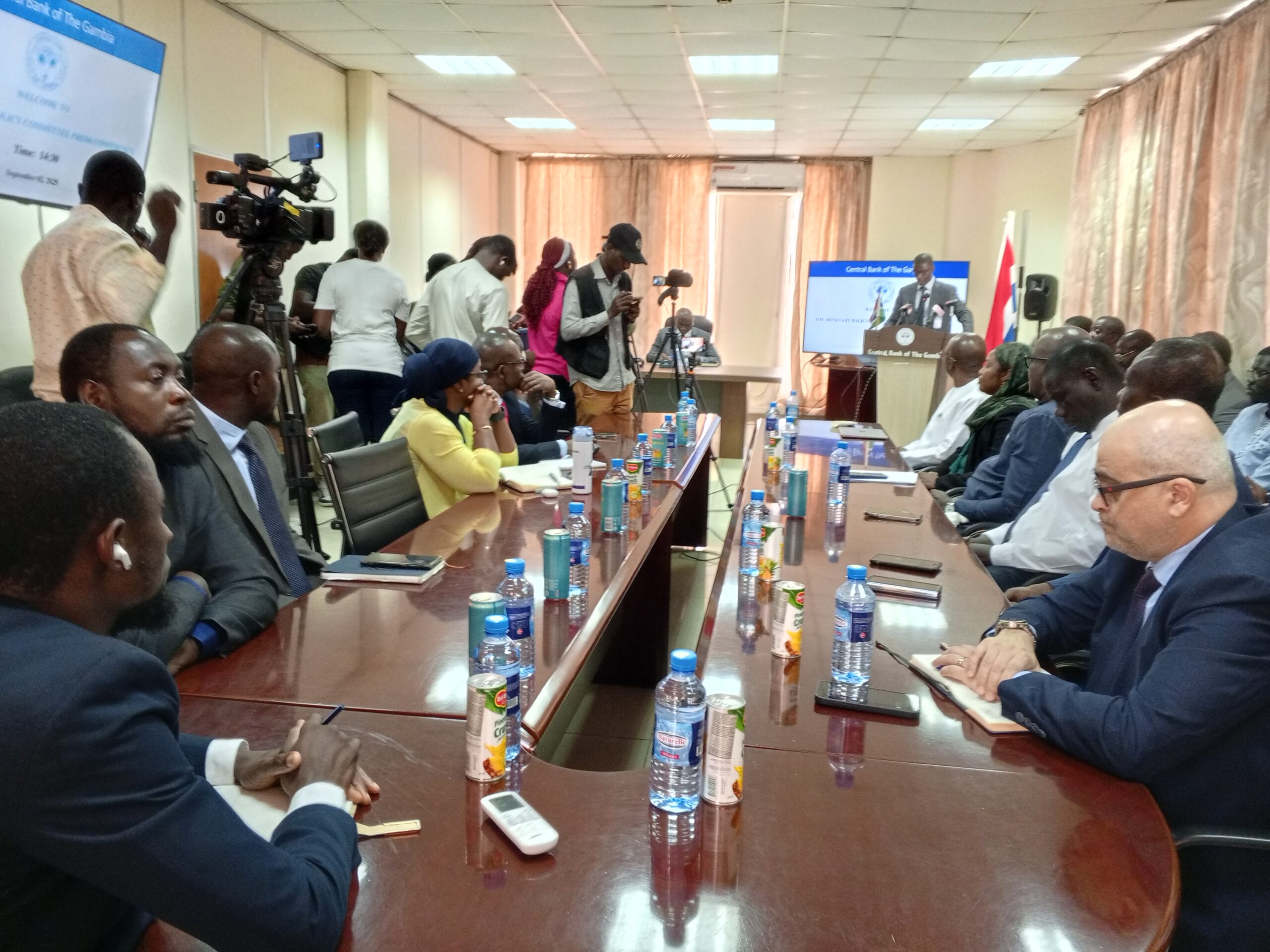


The Gambia has continued to experience a thriving, stable and resilient banking sector since the wake of 2025. Osman Kargbo reports recent developments in the sector.
The banking sector in The Gambia has continued to be stable and resilient, as total industry assets expand, customer deposits rise, and capital adequacy ratio stays strong and healthy. The Central Bank of The Gambia says this fine health of the banking sector is supported and spurred by the sector’s strong capital, improved levels of liquidity and increased profitability.
The latest quarterly Monetary Policy Committee (MPC) report of the Central Bank, released in September 2025 states: “The banking sector continues to exhibit resilience and stability, underpinned by strong capital and liquidity levels and increased profitability. Total industry assets expanded by 7.2 percent between March and June 2025, reaching D110.9 billion, equivalent to 64.3 percent of GDP. Customer deposits also rose, amounting to D81.4 billion or 41.9 percent of GDP, reflecting sustained confidence in the banking sector. The capital adequacy ratio remains robust at 28.4 percent in June 2025, higher than the regulatory requirement of 10 percent. Liquidity conditions improved, with the liquidity ratio strengthening to 78.5 percent, indicating enhanced capacity to meet short-term obligations.”
“The banking sector continues to exhibit resilience and stability, underpinned by strong capital and liquidity levels and increased profitability.”
Buah Saidy
Another good index of the sector’s performance is that the non-performing loan (NPL) ratio declined to 8.9 per cent in June 2025, supported by ongoing loan restructuring efforts and improved repayment conditions. “The industry’s earnings remain strong, registering return on assets (ROA) and returns on equity (ROE) of 3.7 percent and 16.7 percent, respectively,” the MPC report, delivered by the Bank’s Governor Buah Saidy, stated. “The Bank’s quarterly stress test results reaffirmed the sector’s resilience to both capital and liquidity shocks.”
On microfinance institutions, Governor Saidy said this sector of the country’s financial industry maintained strong performance in the first half of 2025, with total assets increasing to D9.3 billion and deposits reaching D7.1 billion as at end-June 2025.
“This growth was underpinned by sound liquidity conditions, adequate capital buffers, and improved risk management,” he says. “Gross loans expanded by 37 percent year-on-year to D1.5 billion, with the bulk of the credit extended to micro, small, and medium-sized enterprises (MSMEs).”
Veering onto the sector of fintech and mobile money operators, reported to have also continued to expand rapidly, reinforcing progress in financial inclusion, the Governor states: “By end-June 2025, registered accounts stood at 4.5 million, of which 2.4 million were active. Cash-in transactions amounted to D20.4 billion, while cash-out transactions totalled D20.8 billion, reflecting the growing use of digital financial services.”
The central bank would nevertheless want to see a much more organised and growing digital financial services sector, hence Governor Saidy reaffirms the Bank’s continued effort towards that direction:“The Central Bank continues to strengthen the regulatory and supervisory framework, enhance cybersecurity resilience, and modernise payment systems infrastructure to ensure that the rapid growth of fintech and mobile money translates into deeper and more sustainable financial inclusion.”
Leaning on this backdrop, most of the commercial banks and other financial institutions in the country have continued to demonstrate that, despite the challenges and vagaries of the global financial and geopolitical system, they are ready to serve the nation by providing fruitful financial services and products that meet the needs and aspirations of the public, as well as by contributing to the growth of the economy in respect of tax compliance, job creation, revenue generation, and corporate social responsibility.
Economy progresses
The Gambia’s economy has continued to grow steadily, registering 5.3 per cent growth last year, with robust growth outlook for 2025.
The MPC report, presented by the Bank Governor, states: “The Gambian economy maintained strong momentum, registering 5.3 per cent growth in 2024. This performance was driven by gains in financial services, trade, construction, and mining. Private remittance inflows and public investment also continue to support domestic demand. The growth outlook for 2025 remains robust, as reflected in the 6.2 per cent average expansion of the Central Bank’s Composite Index of Economic Activity in the first half of the year. Moreover, staff projected a real GDP growth of 6.4 per cent for 2025. Nevertheless, external risks pose significant challenges to the near-term economic outlook. This includes the ongoing trade fragmentation, commodity price volatility, and climate-related uncertainties affecting agriculture.”
“The banking sector continues to exhibit resilience and stability, underpinned by strong capital and liquidity levels and increased profitability.”
Buah Saidy
While general inflation eased to 7.2 per cent in June 2025, “the lowest since late 2021”, the Bank Governor said it, however, increased a bit to 7.5 per cent in July this year due to a slight rise in food inflation.
“Food inflation increased to 8.5 per cent in July, from 7.9 per cent in June 2025, reflecting higher global vegetable oil and meat prices alongside seasoned pressures in perishables,” he stated, saying: “Non-food inflation, by contrast, slowed steadily to 6.1 per cent in July, from 6.3 per cent in June 2025. The decline was aided by subdued global oil prices, as well as stable domestic transport costs and utility tariffs.”
He also said core inflation, which is measured by stripping out energy and volatile food items from headline inflation, increased slightly to 5.8 per cent in July, from 5.3 per cent in June.
On the outlook, Governor Saidy stated, the Bank assessed the July increase in inflation as a “temporary deviation” from the disinflation path of prices and maintained “the forecast that headline inflation will converge toward the 5 per cent implicit target by year-end”.
“Nevertheless, this outlook remains subject to considerable risks emanating from the global economic environment, particularly commodity price volatility and the domestic fiscal policy path,” the Governor expresses cautious optimism.
Upon assessing domestic and global economic conditions and near-term outlook, the Bank’s MP Committee decided to maintain the Monetary Policy Rate (MPR) at 17 per cent, the Required Reserve (RR) ratio of commercial banks at 13 per cent, the interest rate on the standing deposit facility at 4 per cent, and the interest rate on the standing lending facility at 18 per cent, equivalent to MPR plus 1.0 percentage point.